
How Bundaberg State High Transformed Their School Sport Australia Merchandise (And What Other Schools Can Learn From It)
A fictional but realistic case study showing how one Australian school boosted team pride and fundraising revenue through smart school sport Australia merchandise strategies.

Written by
Charlie Kim
Bags & Totes
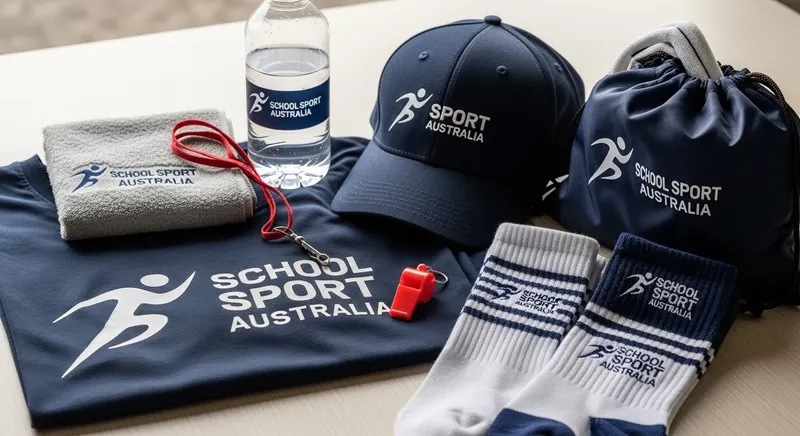
The Bundaberg Experiment: One School’s Journey From Mismatched Kits to State-Level Recognition
When Cassie Thornton took over as Sports Coordinator at a mid-sized state high school in Bundaberg, Queensland, she inherited a cupboard full of problems. Faded polos from three different eras, singlets in two slightly different shades of navy, and a hodgepodge of iron-on logos that had started peeling mid-season. Her swimming squad was heading to the regional championships in Rockhampton, and half the team looked like they’d borrowed their uniform from a sibling who’d graduated years earlier.
“We looked like we didn’t take it seriously,” Cassie recalls in this fictionalised but highly realistic scenario. “But we absolutely did. The kids trained four mornings a week. The coaches gave up weekends. We just hadn’t invested in presenting ourselves properly.”
What followed was an eighteen-month overhaul that turned her school’s approach to school sport Australia merchandise into something other coordinators across the Wide Bay region started asking about. By the end of the following academic year, her school had:
- Outfitted six sporting squads with cohesive, branded performance apparel
- Generated $4,200 in fundraising revenue through supporter merchandise sales at two carnivals
- Reduced their per-student uniform cost by 22% through smarter bulk ordering
- Received formal recognition at the regional School Sport Queensland awards for “programme presentation”
This article breaks down exactly how Cassie’s school did it — and how yours can replicate the approach regardless of your budget, location, or sport.
Step One: Audit What You Have Before You Order Anything New
Cassie’s first move wasn’t to open a catalogue and start clicking. She spent a week inventorying every piece of branded merchandise the school had accumulated over the past decade. The findings were illuminating.
Roughly 40% of the existing stock was either unusable (damaged, wrong sizing, outdated branding) or had been sitting unsorted in storage for so long that nobody could confirm ownership. Another 30% was technically usable but visually inconsistent — the kind of mismatched presentation that undermines team cohesion before a single race is run.
Only about 30% of existing stock was genuinely fit for purpose.
This audit wasn’t just about stocktaking. It gave Cassie a clear picture of what she actually needed versus what she assumed she needed. It also revealed something important: the school had been ordering merchandise reactively, carnival by carnival, without any long-term planning. This reactive approach meant they were consistently paying premium prices for rush orders, missing volume discount thresholds, and ending up with single-use items rather than durable, season-spanning gear.
The lesson for other sports coordinators: Before you spend a single dollar on new merchandise, understand what you already have. A simple spreadsheet tracking item type, quantity, condition, sport, and size range will save you from over-ordering in some areas while leaving critical gaps in others.
Step Two: Build a Merchandise Strategy Around Your Sporting Calendar
Once Cassie had a clear picture of her inventory reality, she mapped her school’s full sporting calendar for the coming year. This is where the strategy got interesting.
The school competed across seven sports at regional or state level: swimming, athletics, netball, rugby league, cross country, basketball, and touch football. Each had different uniform requirements, different seasonal timing, and different squad sizes. Rather than treating each sport as a separate merchandise problem, Cassie looked for commonalities.
She identified three merchandise categories that cut across almost every sport:
1. Performance Uniforms (Sport-Specific)
These are the non-negotiables — the items students actually compete in. For Bundaberg’s climate, moisture-wicking fabrics were essential. Cassie settled on fully sublimated designs for the four highest-profile sports (swimming, athletics, netball, rugby league), which allowed the school’s colours and crest to be incorporated into the fabric itself rather than applied on top.
The key insight here: sublimated garments are more expensive upfront but dramatically cheaper over time. A sublimated singlet that holds its colour and print integrity through 80+ washes at $38 per unit is far better value than a screen-printed alternative at $22 that degrades visibly after a single season. Over a three-year replacement cycle, the cost difference essentially disappeared — and the presentation benefit was continuous.
For cross country, basketball, and touch football, where uniform requirements were simpler, quality screen-printed tees and shorts delivered excellent results at a more accessible price point.
2. Training and Warm-Up Apparel
Cassie introduced a universal warm-up kit — matching hooded jumpers and track pants in the school’s navy and gold — that could be worn across all sports. This meant students representing the school at any carnival would look cohesive in the warm-up area regardless of which team they were on.
The warm-up kit also doubled as a revenue generator. Parents could purchase them through the school, with a modest markup that fed directly into the sports programme fund. In the first year, 84 warm-up sets were sold to students and families, generating approximately $1,890 in programme revenue after costs.
3. Supporter Merchandise
This was the category that genuinely surprised Cassie. She’d initially considered supporter merchandise a nice-to-have — something to explore “when there’s budget.” But after a conversation with a sports coordinator from a school in Toowoomba who was generating over $6,000 annually from supporter gear, she decided to run a test.
For the regional swimming carnival in Rockhampton, she ordered a small run of branded items: 60 bucket hats, 40 tote bags, and 30 stubby coolers, all in school colours with the team name and year printed on them. Total investment: $890.
They sold out entirely. Revenue: $2,310. Net fundraising: $1,420 from a single event.
Step Three: Understand Your Decoration Options (They’re Not All Created Equal)
One of the most common and costly mistakes schools make with merchandise ordering is choosing a decoration method based on price alone, without understanding the long-term implications. Cassie’s school learned this the hard way with an early order of screen-printed polos that started cracking after four washes.
Here’s a practical breakdown of the main decoration methods relevant to school sport Australia merchandise:
Sublimation Printing
Best for: Performance uniforms, swimwear, singlets, cycling jerseys Pros: Colour-permanent, no peeling or cracking, allows full-colour and photographic-quality designs, lightweight Cons: Works only on polyester or polyester-blend fabrics, higher upfront cost Ideal for: Schools wanting durable, high-presentation competition uniforms
Screen Printing
Best for: Cotton or poly-cotton tees, training gear, supporter merchandise Pros: Cost-effective for large runs, vibrant colours on darker fabrics, excellent for simple designs with 1–4 spot colours Cons: Not suitable for complex gradients, can crack on lower-quality applications, less durable than sublimation on performance fabrics Ideal for: Budget-conscious supporter gear and training apparel
Embroidery
Best for: Polo shirts, jackets, caps, bag patches Pros: Premium appearance, highly durable, professional finish Cons: Not suitable for fine details or photographic elements, adds weight to lightweight fabrics Ideal for: Staff uniforms, presentation polos, warm-up jackets with crest branding
Heat Transfer Vinyl (HTV)
Best for: Small runs, personalised names and numbers, one-off items Pros: Low minimum order quantities, fast turnaround for small jobs Cons: Less durable than sublimation or screen printing on high-use items Ideal for: Numbering individual jerseys, last-minute personalisation
Cassie’s school ultimately used all four methods — sublimation for competition uniforms, screen printing for supporter gear, embroidery for warm-up hoodies, and HTV for individual squad numbering.
Step Four: Master the Timeline (This Is Where Most Schools Come Unstuck)
If there’s one universal truth in school sport merchandise ordering across Australia, it’s this: everything takes longer than you expect, and carnival season arrives faster than you planned.
Cassie built a backwards-planning timeline from each major event date and worked out the latest possible order date, then added a two-week buffer. Her findings:
- Fully sublimated custom uniforms: allow 4–6 weeks minimum from artwork approval to delivery
- Screen-printed supporter merchandise: allow 2–3 weeks from artwork approval
- Embroidered items: allow 3–4 weeks depending on complexity and run size
- Rush orders: possible but expensive — typically 25–40% price premium, and quality is sometimes compromised
She also discovered that placing orders in January or February for Term 1 carnivals was infinitely smoother than scrambling in late March. Schools that treat merchandise ordering as an early-year administrative priority rather than a last-minute logistical crisis consistently get better pricing, better outcomes, and zero panic.
Step Five: Build a Sustainable Funding Model
The fundraising results from supporter merchandise changed how Cassie’s school thought about merchandise budgeting entirely. Rather than treating it as a cost centre, the sports programme now treats merchandise as a partial revenue source.
The model that emerged across the following year:
- Competition uniforms funded through the school’s sports budget, amortised over three seasons
- Warm-up apparel available for purchase by students and families, with a 30% margin funding programme costs
- Supporter merchandise sold at carnivals and events, with net proceeds covering travel subsidies for students from lower-income families
This three-stream approach means the programme is no longer entirely dependent on school funding. In a regional Queensland context — where many families face real financial pressure — the ability to subsidise travel costs for representative students has been genuinely transformative.
Several other schools in the Wide Bay region have now adopted similar models after visiting Cassie’s programme at a regional coordinator workshop.
What Other Australian Schools Are Doing Right
Cassie’s story isn’t unique. Across Australia — from primary schools in suburban Perth to regional high schools in rural New South Wales — sports coordinators are discovering that a strategic approach to school sport Australia merchandise delivers returns well beyond aesthetics.
A primary school in the Adelaide Hills used a single carnival supporter merchandise run to fund replacement lane ropes for their pool. A secondary school in Wollongong leveraged sublimated uniforms as part of a broader school identity refresh that increased student participation in representative sport by 18% over two years. A Darwin school found that providing every representative student with a branded warm-up jacket — regardless of family income — improved attendance at training sessions markedly.
The common thread across all these examples: the schools that get merchandise right treat it as a strategic programme asset, not an afterthought.
Practical Checklist for Your Next Merchandise Order
Before you finalise any order for your school’s sport programme, work through these questions:
- Have you audited existing stock and confirmed what genuinely needs replacing?
- Is your artwork print-ready, and does it meet the minimum resolution requirements for your chosen decoration method?
- Have you confirmed squad sizes early enough to include size adjustments before the production deadline?
- Have you built in a two-week buffer beyond the supplier’s quoted lead time?
- Have you considered whether supporter merchandise could offset or partially fund competition uniform costs?
- Are you ordering enough units to qualify for volume pricing thresholds?
- Have you communicated clearly with families about what’s included in the programme fee versus what’s available for optional purchase?
Getting these fundamentals right is the difference between a stressed March scramble and a smoothly executed, professionally presented programme that your students, parents, and community are genuinely proud of.
Custom Merch Co works with school sports programmes across Australia, from Darwin to Hobart, helping coordinators navigate product selection, decoration methods, artwork preparation, and ordering timelines. Whether you’re outfitting a single squad or managing merchandise across an entire school, the approach is always the same: plan early, choose strategically, and make every item count.